
Holland Township Previous Residents by Era
Use the source that fits the period, then carry its address and parcel details to the next source. Ottawa County’s online deed index is a current searchable layer, but it does not publish an official starting year. Earlier deed books and indexes have a different access route. A directory can place a household at an address, while a map can date the building or street context without naming an occupant. The table separates those tasks so a Holland Township past-resident search does not turn a single clue into a conclusion. Holland Township evidence should always retain its source and date.
| Source | Years it covers | Where held | What it shows |
|---|---|---|---|
| Ottawa deed index | Current online coverage; official start year not stated | miOttawa Register of Deeds, counter, and books for gaps | Parties, recording date, document, liber/page, parcel, legal description, and related documents |
| Ottawa deed books and index | Deed records 1834-1939; index 1834-1901 documented | County history channels and FamilySearch images where available | Earlier chain-of-title evidence |
| Kanter, gazetteer, and rural directories | 1894; 1897-98; 1901-02; 1903-04; 1908; 1913-14; 1924-25 | Library and museum holdings to verify | Street occupants, names, businesses, and address context |
| Polk and Bresser reverse directories | Polk late 1800s onward by title; Bresser late 1960s onward | Library of Michigan, Herrick, local collections, and licensed databases | Address-to-head-of-household, phone, tenure, and move clues |
| Federal census | 1790-1950 under the 72-year release rule | National Archives, FamilySearch, and library databases | Household composition, ages, birthplace, and location at the census date |
| Sanborn maps and permits | Sanborn years documented as 1896, 1902, 1908, and 1948; permit summary recaps 2003-2025 | Library of Congress, library or museum, Community Development, or FOIA | Building, street, or alteration context, not an occupant list |
Start with the modern property card if the address exists today. For a nineteenth- or early twentieth-century question, begin with a directory or deed-book period that matches the date, then test the old street form against the legal description and plat.
Trace Holland Township Past Owners Through Deeds
The backwards chain begins with the current parcel, not the current street address alone. The Ottawa County Real Property Search provides a property or situs address, owner, parcel number, government unit, tax description, sales history, split history, and other current card details. Record the legal description as well as the parcel number. A property may have a new PIN after a split, condominium conversion, or master deed, while the legal description can reveal the link to an earlier tract, lot, block, or unit. Confirm that the record’s government-unit field places the parcel in Holland Township.
- Find the current parcel and owner in the county property search. Confirm that the Government Unit corresponds to Holland Township and copy the tax or legal description.
- Open the Ottawa Register of Deeds search and look for the current owner’s acquisition by parcel, party name, document number, or book and page.
- Read the purchase deed’s recording date, document number, liber and page, legal description, and related-document reference. Identify the seller or grantor named in that transaction.
- Search that seller as the earlier grantee, using the same legal description, predecessor parcel, document, or book-page information. Continue the seller-to-earlier-seller sequence one transaction at a time.
- When an online result is absent, try a spelling variant, trust, estate, business name, predecessor parcel, plat, counter search, or records request. An absent web result is not proof that the document never existed.
- Grantor
- The party conveying an interest in a recorded document, often the seller in a deed transaction.
- Grantee
- The party receiving that interest. Searching a prior seller as grantee can locate the earlier acquisition.
- Chain of title
- The sequence of recorded transfers that connects one owner or parcel interest to the prior one.
- Legal description
- The lot, block, unit, master-deed, or metes-and-bounds land description used in the recorded chain. It can survive a street-number change.
Ottawa’s Register of Deeds does not prepare legal documents, certify an abstract, or give legal advice. Treat the document trail as research evidence and consult the appropriate professional when a legal title question requires an opinion.
Holland Township Deed Index Limit
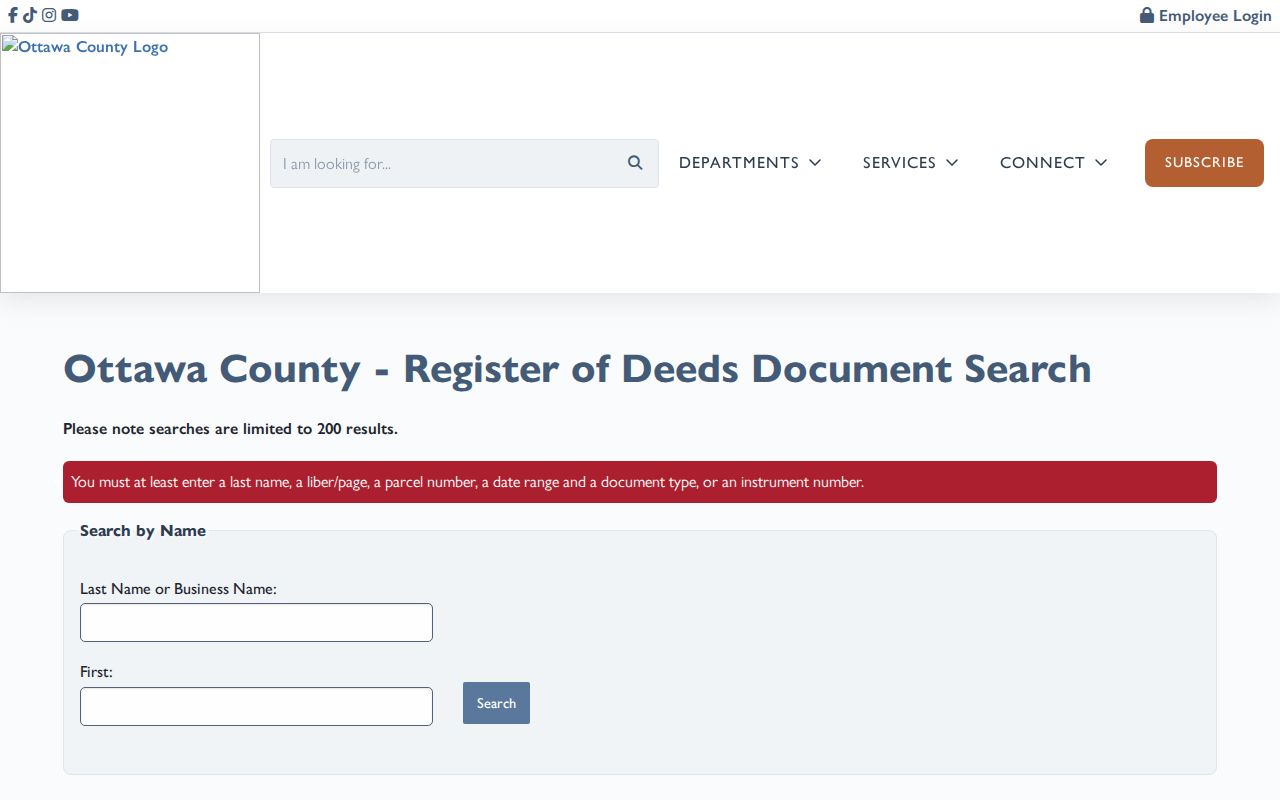
The Ottawa deed search has distinct modes for party name, recording-date range and document type, liber and page, instrument number, and parcel number. A typical result shows Record Date, Party 1, Party 2, Doc No, Doc Type, Liber & Page, Parcel No, and Related Doc. The index is free, but online images cost $1 per page plus technology or convenience charges. Results are capped at 200, so a broad surname or parcel search should be narrowed by date or document type. This limit is especially useful to remember on a long Holland Township ownership trail.
A document number containing U has no online image. The office counter, telephone, and email channels remain available when an image or older link is missing. FamilySearch catalog coverage documents Ottawa deeds from 1834 through 1939 and an index from 1834 through 1901, with image access varying by collection. That is a historical route, not a promise that every image will display at home.
The Register of Deeds search form below shows the party, date, book-page, instrument, and parcel choices used to work backward.
Record each transfer on a worksheet with the current address, parcel, legal description, grantor, grantee, date, instrument, liber/page, and next source. This keeps a copied owner name from becoming detached from the parcel it actually concerns.
Holland Township Past Residents in Local Directories
Holland-branded directory titles can cover township or rural places, but their coverage must be checked before assigning an entry to a Holland Township address. The documented local sequence includes J.D. Kanter’s 1894 business and city directory; Kanter’s 1897-98, 1901-02, 1903-04, and 1913-14 Holland directories; the 1908 City Directory & Ottawa County Gazetteer; and the 1924-25 multi-community rural directory. The rural volume is especially useful when a household falls outside a title city’s core. A Holland Township entry needs that geographic check in every volume.
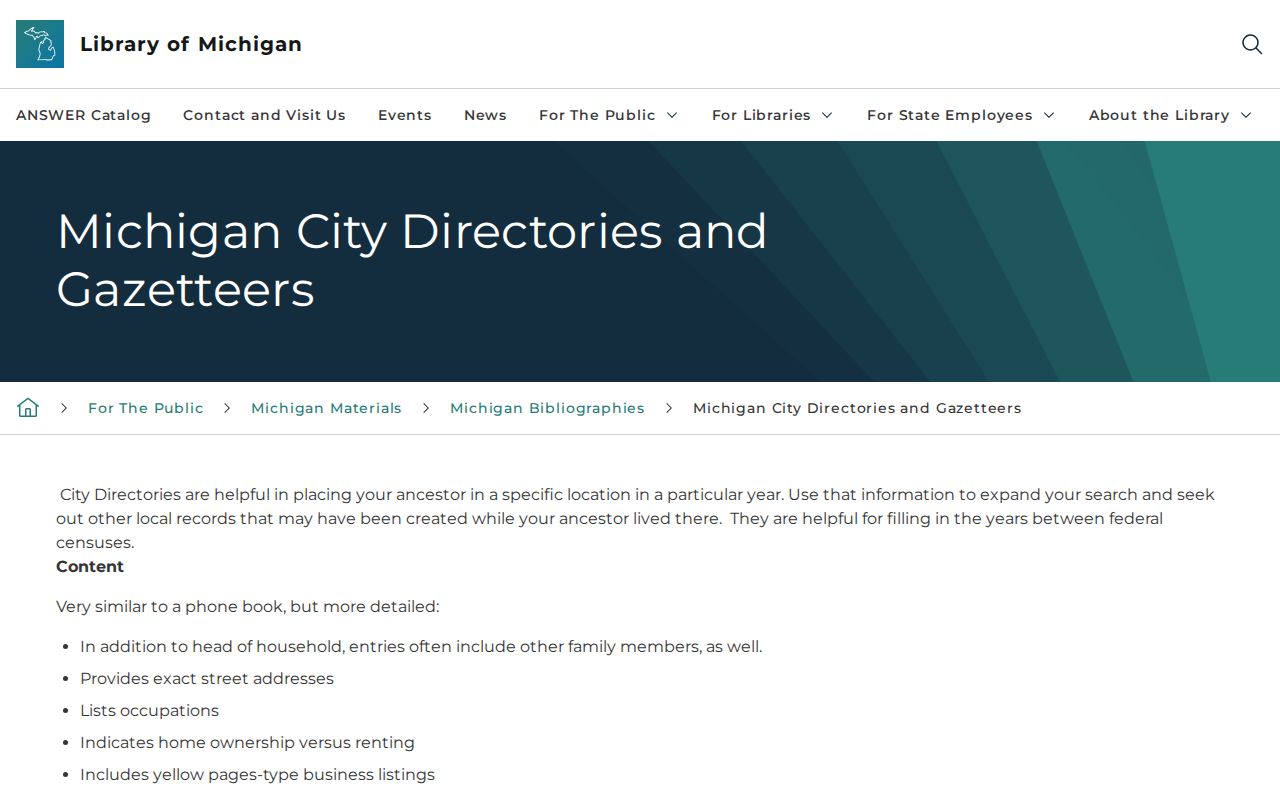
The Library of Michigan directory guide distinguishes Polk’s name, street, and phone access from Bresser’s reverse format. Polk street pages are alphabetical by street and then numerical by address. Bresser’s street-to-household entries generally give a head of household, phone, tenure notation, and first-listing or relocation clues. The documented collections themselves are described in the Holland Township city directories, while a past-resident search uses the relevant issue as one point in a longer address timeline.
The Library of Michigan directory guide image shows the collection route for Polk and Bresser research.
Do not read a directory entry as a deed. It can establish that a listed person or household appeared at an address in that edition, while recorded land documents establish a different type of evidence about the parcel.
Pair Holland Township Past Households with Census
A past-resident question often shifts from ownership to household composition. Pair a directory year with nearby federal census years rather than treating either source as complete. Census images and indexes are public through 1950 under the 72-year rule. They can provide age, birthplace, relationship, and household context at the census date. A directory can supply an intermediate street address, surname form, occupation, spouse or other household name, and sometimes a move or tenure clue. The Holland Township comparison needs both date and geography.
- Copy the address exactly as it appears in the directory, including direction and suffix. Record the volume date and whether it is a name section or a reverse street section.
- Search the preceding and following directory issues for the same address. A family can move while the address stays fixed, or the address can change while the surname persists.
- Pair the address period with the 1900, 1910, 1920, 1930, 1940, or 1950 census as appropriate. Compare township, ward, precinct, legal description, and neighboring names before accepting a match.
- Use a deed, tax roll, plat, obituary index, or probate file to test an important transition. A widow notation, new surname, or vanished entry is a lead, not final proof.
Holland Township history also matters in the oldest records. The township was created in 1847, and the Groningen road connection moved in 1856, shifting enterprises to New Groningen. Search those settlement labels in nineteenth-century directories, church material, and maps before concluding that an early Holland Township household is absent.
Holland Township Previous Residents and House Context
Sanborn maps and building records can clarify the physical setting behind a past-resident search. Holland Sanborn maps are documented for 1896, 1902, 1908, and 1948. The Library of Congress offers a public-domain 1908 Holland set of 28 sheets. Those maps show building footprint, use, materials, and street context, not the people living there. Holland Township permits and building reports can date construction, alteration, or project activity by job-site address or parcel, but no public online permit-case lookup was located. Request a specific existing file through Holland Township Community Development or township FOIA.
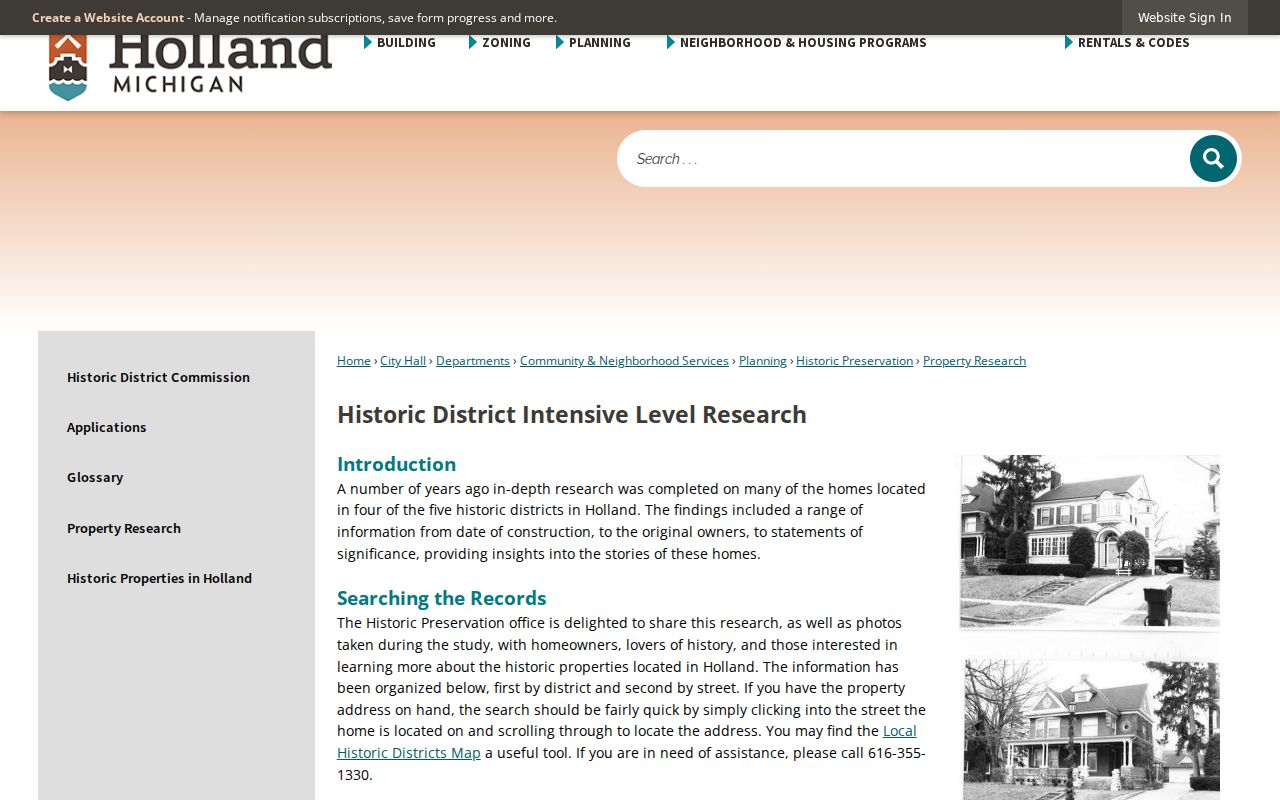
The City of Holland historic-property research page is organized by district, street, and address. For listed city historic districts, it can surface construction dates, original owners, photos, and significance. It does not provide full Holland Township coverage. For a township address, use it only when the parcel truly falls within its city subject area, then return to the township assessor, county parcel system, and museum holdings.
The historic-property research landing page below shows the city’s district-to-street-to-address route.
Use a map or permit to explain the place and date a building change occurred. Do not convert it into proof that a named former resident owned or occupied the property.
Holland Township Previous Residents at Trail Endpoints
For a former occupant who disappears from the directory trail, the Holland Sentinel obituary index can supply a date and page lead. The documented index covers 1912-1974. Herrick District Library’s People and Subject Indexes can point to local obituary, business, wedding, civic-event, and death-notice material before a researcher opens a newspaper image. A notice may identify family, a former address, or an event that explains a surname change. It is still a lead that should be compared with the original newspaper page and other Holland Township evidence.
Probate can be the next endpoint when a death record or obituary identifies an estate. Ottawa County Probate files are connected to the 20th Circuit court structure, while MiCOURT is the public web case route for participating material. Wills are excluded from the public MiCOURT display, so ask Probate Court about file access and copy rules. The route is useful for a decedent, fiduciary, heir, or later deed connection when the public file permits access.
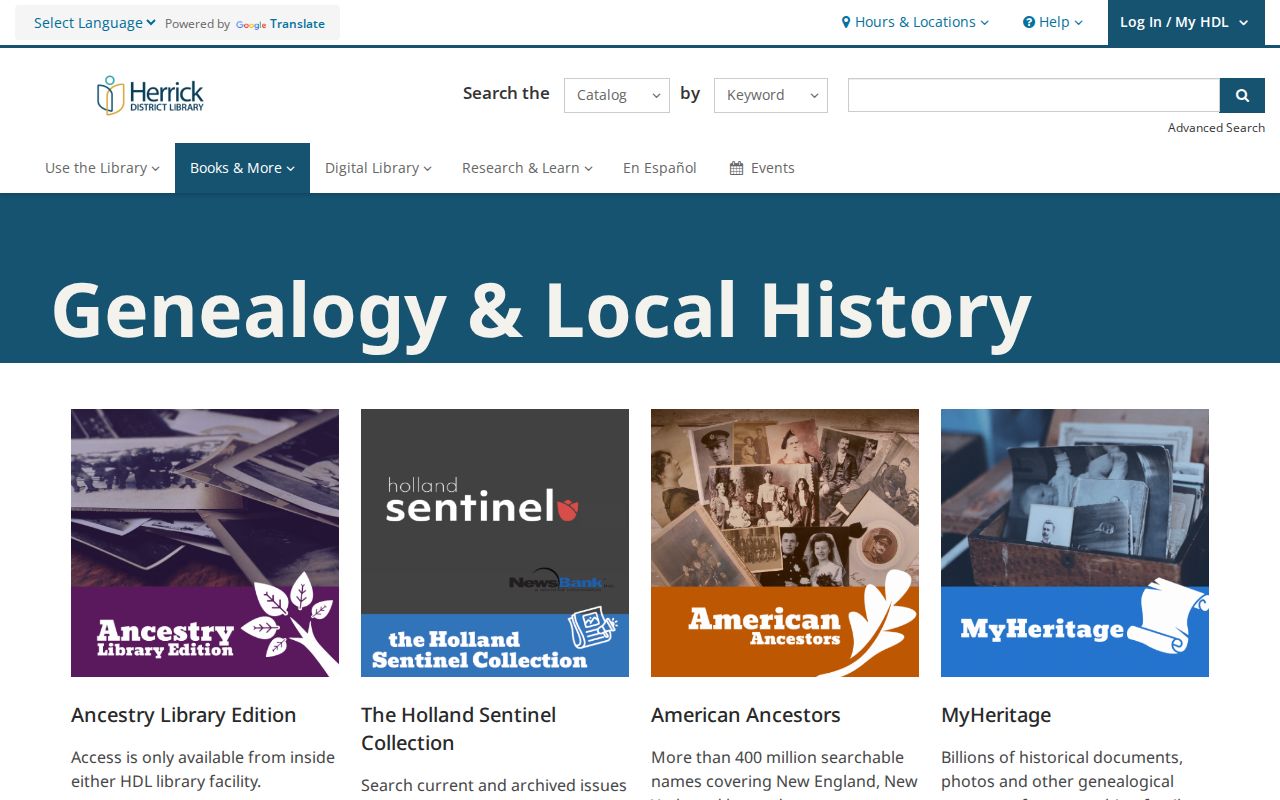
The Herrick genealogy and local-history page shown below is a local entry point for newspapers, cemeteries, Dutch genealogy, and related historical sources.
Herrick and the Holland Museum are especially useful when a directory title, surname form, newspaper date, or settlement label needs local context. Request the specific issue, date, address, or collection rather than asking for a compiled list of private people.
Holland Township Deed Trail Monitoring Tip
Past-resident research often leads to a newly discovered recorded document. Ottawa County’s Winter 2025 notice describes Property Fraud Alert as a free service that sends phone, text, or email notice when a document is recorded under a subscribed name. The notice directs recipients to verify an alert with the Register of Deeds. It is useful monitoring for a name associated with a current Holland Township property interest, but it is not a title search and does not replace a chain-of-title review.
That limitation is important. A deed index can disclose a recorded document after the fact, while a full historical chain requires the parcel, legal description, prior-document references, plat material, and the custodian’s copies when the web record is incomplete.
Note: Keep the source date with every document reference because property, deed, and directory data can be corrected or re-indexed after a search.
Limits on Holland Township Past Resident Research
Previous residents, past residents, and past owners are not interchangeable terms. A deed identifies a recorded transfer, not all people who lived at the property. A directory can list an address or head of household for a particular edition, not a complete household for every year. Census records are date-specific. Maps and permits describe property context, not occupants. Keep owner, mailing address, situs address, directory occupant, and historical address in separate Holland Township columns when making notes.
Michigan privacy rules still matter for newer records. The Michigan Address Confidentiality Program can provide eligible participants with a substitute address, and voter records have defined redactions. Ask the record custodian about an apparent error, protection, or correction process. A Michigan FOIA request should seek an existing record by parcel, document number, address, case number, or date range rather than asking an office to create a new list from several private systems.
Lawful use. Use Holland Township house-history and family-history records for lawful personal research and verify them with the custodian. Never use a past-address trail to stalk, harass, intimidate, or harm anyone.